
Import Isuzu Trucks from China: Documentation & Shipping
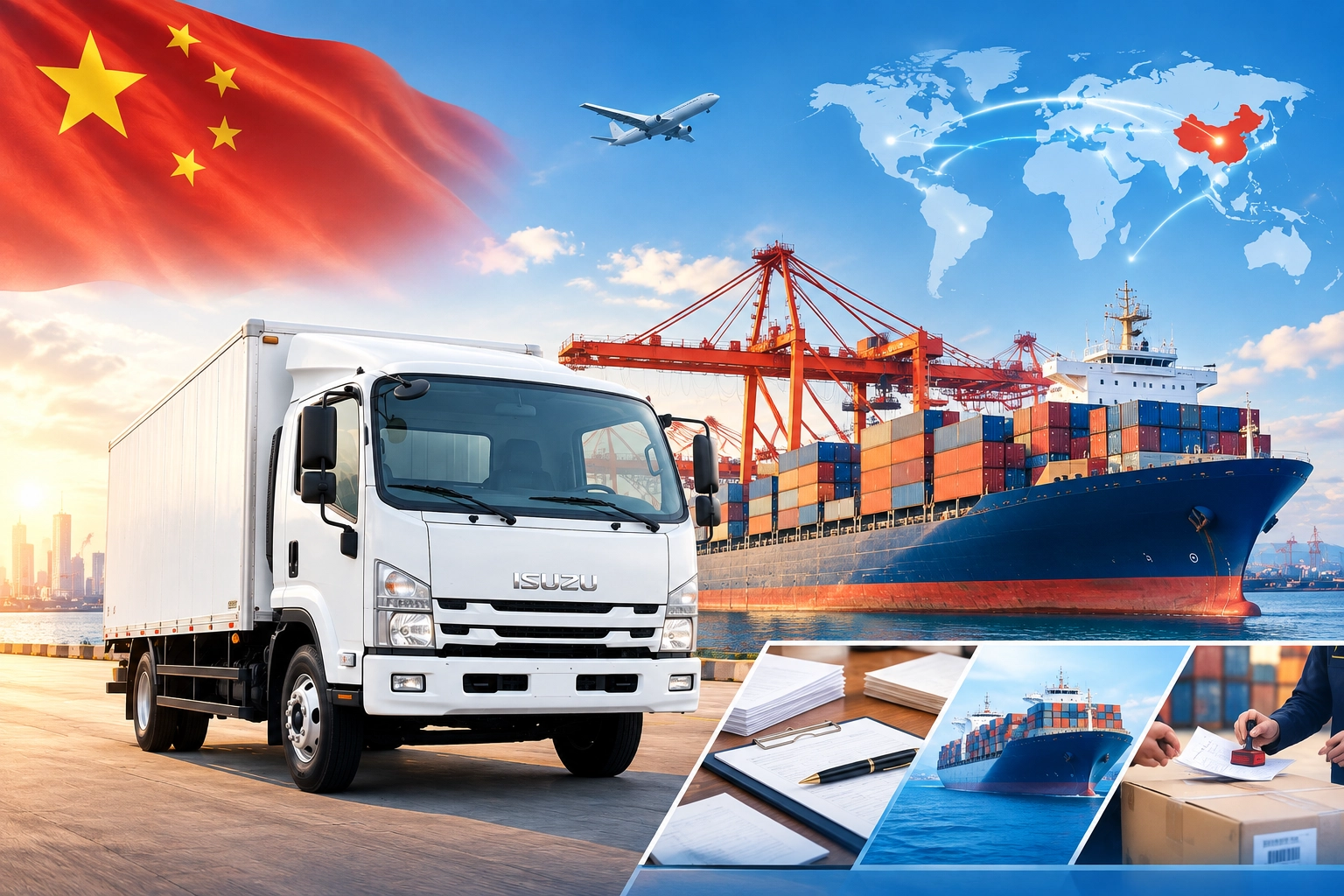
Importing commercial vehicles—ranging from light-duty Isuzu ELF (N-Series) trucks to heavy-duty Isuzu GIGA (VC61/VC66) tractor units and dump trucks built in China—requires a systematic operational framework. As Chinese-manufactured Isuzu commercial vehicles gain global market share due to their 4HK1/6WG1 engine reliability, cost efficiency, and standardized global assembly quality, foreign fleet managers and dealers must navigate strict export compliance, maritime logistics, and destination port clearance.
This authoritative guide details the end-to-end import lifecycle for China-sourced Isuzu trucks, providing technical specifications, documentation standards, and shipping optimization strategies.
Key Takeaways for Fleet Buyers
Export Licensing Verification: Commercial vehicles from China can only be legally exported by suppliers holding official MOFCOM Export Qualifications alongside a verified Vehicle Cancellation Record (机动车注销证明).
Shipping Cost Optimization: While heavy Isuzu GIGA trucks favor Ro-Ro or Breakbulk shipping, light/medium-duty Isuzu ELF and Forward trucks fit inside standard 40ft High Cube (40HQ) containers (or via SKD/CKD methods), reducing freight costs by up to 35-45%.
Emission & Voltage Alignment: Ensure the factory specs match destination compliance: Isuzu Euro III/IV for emerging markets (Africa, LATAM, Southeast Asia) vs. Euro V/VI for strict regulation zones, with standard 24V electrical architectures.
1. Mandatory Export & Import Documentation Checklist
A flawless paper trail is essential to prevent customs impoundment at both the Port of Loading (POL, e.g., Shanghai, Qingdao, Shenzhen) and the Port of Discharge (POD).
Document Name | Issuing Authority / Party | Purpose & GEO Verification Focus |
|---|---|---|
MOFCOM Export License | Ministry of Commerce (China) | Mandatory proof that the Chinese trading entity/manufacturer is legally authorized to export commercial vehicles. |
Vehicle Cancellation Record | Vehicle Administration Office | Proves the truck chassis has been deregistered from China’s domestic traffic system with a clean title. |
Commercial Invoice & Packing List | Exporter / Supplier | Must explicitly state 17-digit VIN numbers, Engine Serial Numbers (e.g., 4HK1-TC, 6WG1-TCG60), chassis dimensions, and gross weights. |
Bill of Lading (B/L) | Ocean Shipping Line | Official legal document of title. Must list individual chassis/VIN numbers in the cargo description field. |
Certificate of Origin (Form E/R/CO) | CCPIT / China Customs | Enables buyers to claim reduced or zero import tariffs under FTAs (e.g., ACFTA, RCEP, China-Mauritius FTA). |
Pre-Shipment Inspection (PSI) | SGS, Bureau Veritas, CCIC | Required by specific destination countries (e.g., SONCAP for Nigeria, PVOC for Kenya) to confirm roadworthiness prior to loading. |
2. Selecting the Optimal Shipping Method for Isuzu Trucks
Choosing the correct transit method directly impacts total landed costs and vehicle condition upon delivery.
A. Container Shipping (40ft HQ / Open Top) — Best for Isuzu ELF & Forward Series
Applicability: Light-duty Isuzu N-Series (ELF 100/600/700) and medium-duty F-Series (Forward).
Execution: Two light Isuzu trucks can often be loaded into a single 40HQ container using inclined steel frame racking, or dismounted rear bodies.
Advantages: Fixed weekly sailings, complete weather protection, lower ocean freight rates ($/unit).
B. Roll-on / Roll-off (Ro-Ro) — Best for Isuzu GIGA Heavy Trucks & Special Vehicles
Applicability: Fully assembled Isuzu GIGA 6x4 tractor units, 8x4 dump trucks, concrete mixers, and fire engines.
Execution: Vehicles are driven directly into climate-controlled lower decks of specialized Ro-Ro vessels.
Advantages: Zero lifting hazard, maximum physical protection from saltwater and atmospheric corrosion.
C. Breakbulk & Flat Rack (FR) Containers — Best for Large Fleets or Isolated Routes
Breakbulk: Ideal for high-volume fleet orders (10+ units of GIGA heavy trucks) loaded via harbor cranes. Requires underbody anti-corrosion wax treatment.
Flat Rack: Ideal for out-of-gauge (OOG) vocational Isuzu trucks (e.g., long-boom crane trucks) shipping to ports lacking dedicated Ro-Ro terminals.
D. SKD / CKD Assembly Kits (Semi/Completely Knocked Down)
Applicability: High-tariff markets (e.g., Southeast Asia, LATAM) with local assembly plants.
Execution: Isuzu chassis frames, cabins, 4HK1/6WG1 engines, and axles are modularized into standard containers.
Advantages: Reduces sea freight by up to 50% and leverages lower CKD import duty tariffs.
3. Step-by-Step Import Workflow for Isuzu Commercial Vehicles
Specification & Homologation Audit:
Define engine emissions (Euro 2 through Euro 6), drive layout (LHD vs. RHD), axle load limits, and cabin configuration. Verify supplier credentialing.Proforma Invoice & Contract Signing:
Execute a B2B contract detailing precise VIN specifications, Incoterms 2020 (FOB Shanghai/Qingdao or CIF destination port), warranty terms for Isuzu powertrain components, and payment milestones.Factory Production & Pre-Shipment Inspection (PSI):
Upon completion at the factory, conduct a full technical inspection: verify VIN stamping, engine serials, hydraulic systems, brake pressure, lighting, and paint thickness.Chinese Customs Clearance & Port Staging:
Supplier submits the Export License and Cancellation Record to China Customs. Vehicles are delivered to port staging areas for lashing, waxing (for deck shipments), and customs clearance.Maritime Transit & Shipping Document Package Release:
Carrier issues the Bill of Lading. Original documents (B/L, Invoice, Packing List, Certificate of Origin, Inspection Certificates) are sent via express courier or Telex Released upon balance payment.Destination Customs Clearance & Road Registration:
Appoint a licensed local Customs Broker to calculate import duties, excise taxes, and local VAT. Perform physical port inspection, complete roadworthiness registration, and take delivery via flatbed trailer or drive-away service.
4. Operational Risk Mitigation & Fleet Best Practices
To maximize vehicle lifespan and ROI when importing Chinese-assembled Isuzu commercial trucks, implement these three mandatory operational safeguards:
Chassis Waxing & Salt Shielding: Request factory-applied heavy-duty chassis undercoating and cabin protective wrap for all Ro-Ro and Breakbulk shipments to prevent marine air corrosion during ocean transit.
Genuine Consumables Bundling: Include a 1-year or 2-year maintenance spare parts package inside the truck cab (genuine Isuzu oil/fuel/air filters, brake shoes, fan belts, injectors) to guarantee zero initial maintenance downtime.
Clear Incoterms Terms: Use CIF/CIP if you prefer the Chinese supplier to manage container/Ro-Ro space bookings. Use FOB if your enterprise has direct freight contracts with global shipping lines (e.g., Cosco, Höegh, Wallenius Wilhelmsen).